
One Year of Watching Sign Language AI: Progress, Pressure, and a Warning Before Boston

Updated: May 12
Tomorrow, the SLxAI conference in Boston begins.
I will not be there. I have teaching work and contracts to honour. But I have spent the past year watching this space closely, writing about it, questioning it, and trying to understand where it is going.
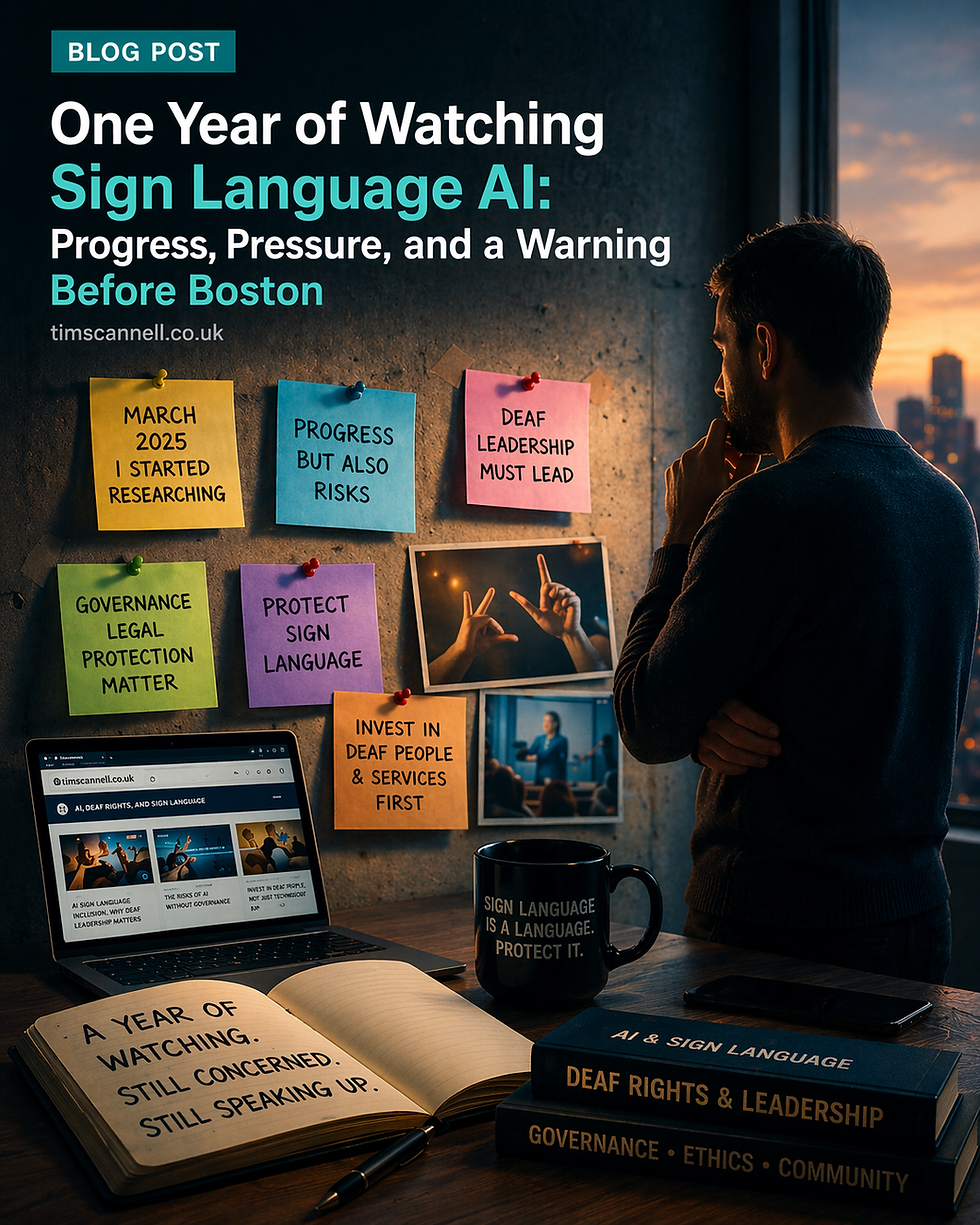
Since March 2025, I have been researching and reflecting on AI and sign language through this blog. Over that time, I have seen some promising ideas, some important discussions, and also some serious warning signs.
There is clearly energy in this field. People want to build systems that can use sign language as input and output. They want tools for websites, communication, services, education, and public access. I can see the ambition, the technical skill, and the excitement.

But progress alone is not enough.
Coding, design, testing, and delivery are all ongoing. Nothing is finished. Nothing is settled. And in my view, this work is moving into dangerous territory if governance, legal protection, and Deaf-led leadership do not keep pace.
That is where my concern lies.
I can see strengths in Sign Language AI. There are good starts. There are people trying to solve difficult problems. Some of the work is thoughtful and worth watching.
But I can also see weaknesses.
Some projects appear to move too quickly. Some seem to treat sign language as something that can simply be captured, processed, and reproduced, without enough respect for language, culture, ownership, or community authority. Some look impressive on the surface, but the deeper questions remain unanswered: Who leads? Who benefits? Who is accountable? Who protects the language? And who decides what “good enough” means?
These are not side issues. They are central issues.
For Deaf people, sign language is not just content, movement, or a technical challenge. It is language, identity, culture, history, and community. That is why this work cannot be left only to programmers, designers, investors, or institutions. Technical skill matters, but it is not the same as Deaf authority.
This is why so many of us remain concerned about the lack of Deaf leadership in parts of this field.
Too often, Deaf people are brought in late, asked for feedback, or used as part of a presentation and consultation. That is not the same as leadership. That is not the same as authority. If Deaf people are not leading this work from the beginning, then the balance of power is still wrong.
And history matters here too.
Deaf communities have long memories. We know what happens when other people decide what is best for sign language without Deaf leadership. We know what happens when language is controlled, reduced, or pushed aside in the name of progress. That is why today’s AI discussion cannot be separated from the history of sign language oppression.
Another issue that concerns me deeply is money.
Before AI, more money went into services for Deaf people and Deaf communities.

Now, during the rise of AI, large amounts of money can be found for AI projects, pilots, experiments, and innovation programmes. But where is that same energy when Deaf clubs need support? When Deaf sport needs investment? When Deaf education is struggling? When Deaf foundations, organisations, and trusted community services are under pressure?
This is the question I keep coming back to.
If millions can be found for AI, why is there still not enough for Deaf services?
If people are willing to invest in systems, why are they less willing to invest in Deaf places, Deaf organisations, and Deaf-led community life?
Technology must not become an excuse to reduce human services.
AI must not become a reason to divert money away from Deaf communities.
And AI must never be presented as progress if it grows while real Deaf services shrink.
That is not inclusion. That is not justice. That is not community progress.
I am not against innovation. I am not against research. I am not against exploring the possibilities of AI in sign language.
But I am against moving too fast without protection.
I am against weak governance.
I am against poor accountability.
I am against sign language being treated as a resource to extract from, rather than a language to protect.
And I am against any future where AI receives more value than Deaf people themselves.
My position is simple.
If Sign Language AI is going to develop, then it must be built on strong governance, legal accountability, and genuine Deaf-led leadership. It must protect sign language, not weaken it. It must support Deaf communities, not replace or undermine them. And it must never be funded at the expense of Deaf services, Deaf spaces, and Deaf lives.
So as the conference begins in Boston, I hope people ask harder questions.
Not only what AI can do.
But who does it serve?
Who controls it?
Who benefits from it?
Who is missing from leadership?
And what happens to Deaf communities if technology rises while services fall?
After one year of watching this space closely, I still believe there is potential here.
But potential without protection is risky.
Innovation without Deaf leadership is not enough.
And investment in AI without equal or greater investment in Deaf communities is the wrong direction.
Invest in Deaf people, Deaf services, and Deaf-led leadership first, then talk about AI.
Comments are available at the bottom of each blog post. Simply open the post and scroll down to join the conversation.


Important message from the World Federation of the Deaf - https://www.linkedin.com/posts/wfdeaf_the-wfd-president-recently-delivered-a-presentation-activity-7452335345792200705-VsV5?utm_source=share&utm_medium=member_desktop&rcm=ACoAAAfVDxEBUlYb7g-FMydDz_Dy9BiPrexkXwM
This connects strongly with my own recent post on Sign Language AI. I welcome innovation, but only when it is deaf-centred, grounded in rights, and led by Deaf people. AI must not move faster than governance, legal protection, and accountability.
We must be careful that growing interest in AI does not come at the cost of Deaf services, Deaf education, Deaf community spaces, and Deaf leadership.
My view remains simple: invest in Deaf people first, then talk about AI.
Appreciate these reflections from people who attended the SLxAI conference in Boston. One raises important questions about cost and transparency, and another highlights the risk of AI being presented in ways that people may misunderstand as equivalent to human interpreters. Both are worth reading. Innovation matters, but so do honesty, Deaf leadership, accountability, and protecting the role of qualified human interpreters.
1) https://www.linkedin.com/posts/craigjradford_i-just-attended-the-slxai-conference-in-boston-share-7451123086969729024-EKbv?utm_source=share&utm_medium=member_desktop&rcm=ACoAAAfVDxEBUlYb7g-FMydDz_Dy9BiPrexkXwM
2) https://www.linkedin.com/posts/ryanhaitcampbell_reflecting-on-the-slxai-2026-conference-in-share-7451354312158633985-U985?utm_source=social_share_send&utm_medium=member_desktop_web&rcm=ACoAAAfVDxEBUlYb7g-FMydDz_Dy9BiPrexkXwM
https://www.nbcboston.com/video/on-air/as-seen-on/ai-tool-translates-asl-in-real-time/3935023/
I’ve now published the full blog article with visual images and a deeper reflection on Sign Language AI, Deaf leadership, governance, and protection of our language. Please read the full piece here:
https://www.timscannell.co.uk/post/one-year-of-watching-sign-language-ai-progress-pressure-and-a-warning-before-boston