
Why sign language AI errors are not the translator’s fault
- Tim Scannell
- Feb 10
- 2 min read

Updated: Apr 4
Spatiality and phonology are core parts of sign language. Many current AI systems still struggle to represent them accurately.
When errors appear in AI-generated sign language, responsibility is often implicitly placed on the human sign language translator involved. This is unfair and incorrect.
In most systems, translators are not delivering sign language directly to the AI. They are contributing to datasets, often in the form of sign language gloss. Gloss is a simplified representation and cannot fully capture spatial grammar, phonology, facial expression, or timing.
This is a system and dataset limitation, not a human failure.
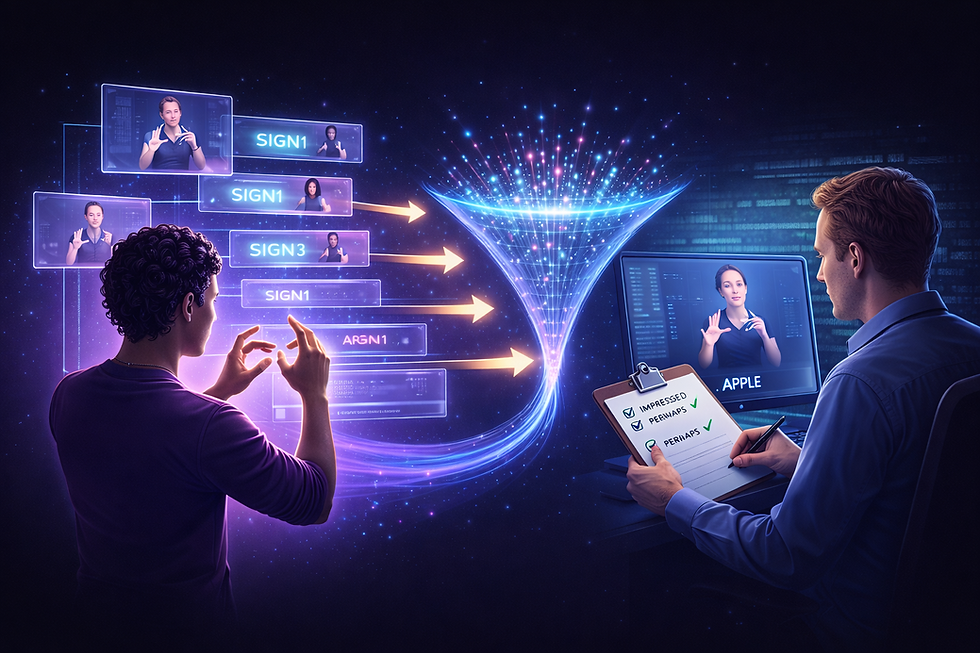
A Deaf person stands on the left side of the image, signing with both hands. Around them are several floating video panels showing different moments of sign language input, representing recorded sign data. These panels flow through a glowing, funnel-shaped visual in the centre, suggesting data processing.
On the right side, a hearing person sits at a desk in front of a computer screen, reviewing the sign language output. The screen shows a sign video with a mismatched spoken-language label, indicating an incorrect interpretation. The person holds a clipboard and appears to approve the result without recognising the error.
The background is dark and futuristic, with soft glowing lights and abstract digital elements, emphasising the gap between sign language input and human approval of the final output.
I also notice something important about how people watch these systems.
You focus on the sign language first.
If you do not understand it, only then do you read the subtitles.
This shows that sign language and subtitles serve different purposes. They are not interchangeable and should not be treated as the same output.
If AI systems ignore this distinction, they will continue to fail sign language users — even when the subtitles appear correct.


Comments