
The Future of Accessible Communication
- Tim Scannell
- Jul 1
- 3 min read

Updated: Jul 4
Why Accessibility Should Travel With You
By Tim Scannell

We Are Thinking Too Small
For decades, accessibility has focused on improving individual products.
We have made enormous progress.
Websites now support screen readers.
Videos include captions.
Smartphones offer accessibility settings.
Sign language interpretation is becoming increasingly accessible.
Artificial intelligence is beginning to provide real-time captions, translation and communication support.
But one question keeps coming back to me.
Why does accessibility still depend on the device I'm using?
Every time we buy a new phone, use a different computer, walk into a meeting room or visit a public venue, we often have to configure accessibility all over again.
Perhaps we've been solving the wrong problem.
Accessibility Should Belong to the Person
Imagine arriving at:
a football stadium
a theatre
a hospital
a university
a workplace
an airport
Instead of searching through menus or downloading another app, your accessibility preferences are already available because you've chosen to share them.
Not your personal data.
Not your identity.
Simply the communication preferences you want the environment to respect.
Accessibility becomes part of you - not part of the device.
One Profile. Endless Possibilities.
Imagine a personal accessibility profile containing your preferred communication methods.
It might include:
Real-time captions
Speaker identification
British Sign Language
Preferred language
High-contrast display
Audio description
Simplified text
Font size
Colour preferences
Every compatible system understands those preferences.
Whether you're using smart glasses, a transparent display, an augmented reality headset or a future technology that hasn't yet been invented, the experience remains consistent.
The technology changes.
Your accessibility does not.
Communication That Stays With the Conversation
Today's captions usually appear at the bottom of a screen.
That means looking away from the speaker.
Looking away from facial expressions.
Looking away from body language.
Imagine instead that communication appears beside each person as they speak.
At a football match, the coach's instructions appear next to the coach.
The player's reply appears beside the player.
In a meeting, captions stay with each speaker.
Eye contact becomes natural again.
Communication feels more human.
Beyond Today's Devices
The future is not about one product.
It could include:
Smart glasses
Transparent displays
Heads-up displays
Mixed reality devices
Holographic interfaces
Wearable technology we have not yet imagined
The hardware will continue to evolve.
The principle should remain the same.
Accessibility should follow the individual.
This Isn't Just About Deaf People
Although my work focuses on Deaf communities and British Sign Language, this vision benefits everyone.
Imagine:
A Deaf person receiving captions or BSL.
A blind traveller hearing audio guidance.
A visitor is reading information in their preferred language.
A person with dyslexia viewing simplified text.
Someone with low vision automatically receives larger, higher-contrast content.
A person with cognitive accessibility needs clearer communication.
The information doesn't change.
Only how it's presented.
The Next Challenge Isn't Technology
Technology is advancing rapidly.
Artificial intelligence can already recognise speech, translate languages and generate captions.
The bigger challenge is governance.
Questions such as:
Who controls accessibility preferences?
How are they protected?
How does consent work?
Can people choose exactly what they share?
How do different systems communicate using common accessibility standards?
These questions may prove even more important than the technology itself.
From Universal Design to Personal Accessibility
Universal Design taught us to create environments that work for as many people as possible.
The next evolution may be something even more personal.
Instead of designing one experience for everyone, we design systems that adapt to each individual while respecting privacy, dignity and choice.
Accessibility becomes personalised, portable and available everywhere.
Looking Ahead
I don't believe the future of accessibility belongs to one company or one product.
It belongs to an idea.
An idea where communication adapts to people rather than expecting people to adapt to technology.
Whatever devices we use in the years ahead, accessibility should no longer be something we switch on.
It should simply travel with us.
About the illustration
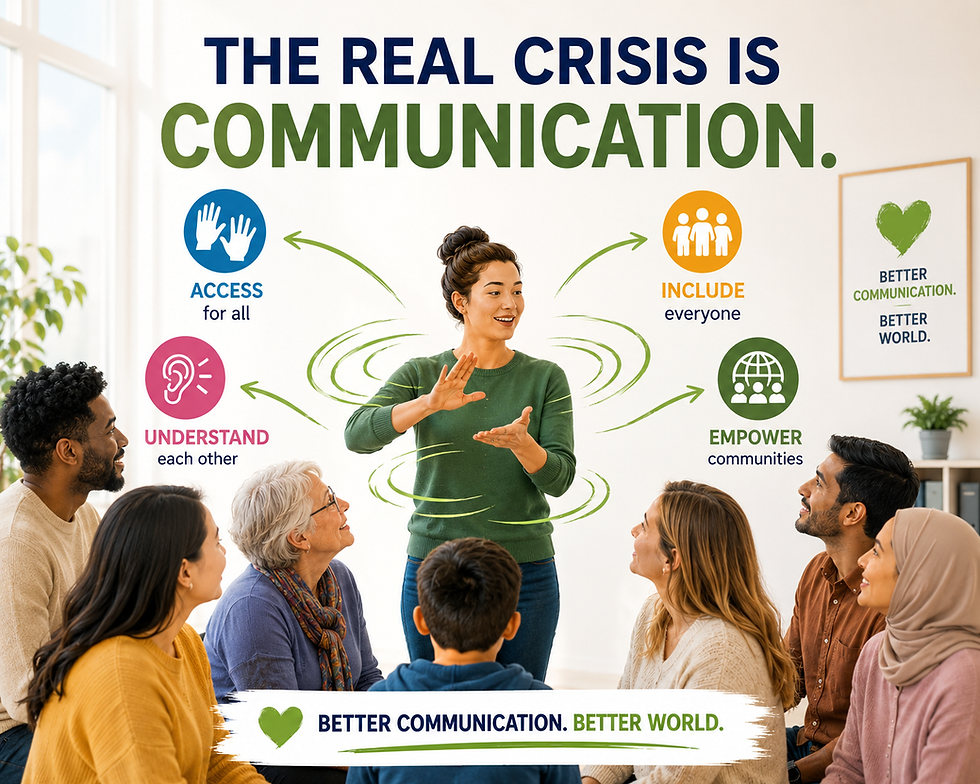
The infographic accompanying this article captures that vision well. It shows how a single accessibility profile could work across multiple technologies - smart glasses, transparent displays, holographic interfaces and heads-up displays—while keeping communication centred on the people involved rather than on the device itself.


Comments