
Accessibility Maturity: Why Most Organisations Are Still on Step One
- Tim Scannell
- Jun 29
- 3 min read

Over the past few weeks, I have had conversations with organisations about accessibility, communication, sign language, websites, training, and technology.

Artificial Intelligence often entered the discussion.
But something interesting stood out.
Very few organisations started by asking about AI.
Instead, they asked questions such as:
How do we improve communication?
How can we better support Deaf people?
How do we make our services more accessible?
How do we introduce sign language?
How do we improve the user experience?
These conversations left me thinking about accessibility in a different way.
Perhaps accessibility is not a technology challenge.
Perhaps it is a maturity challenge.
The Accessibility Maturity Journey
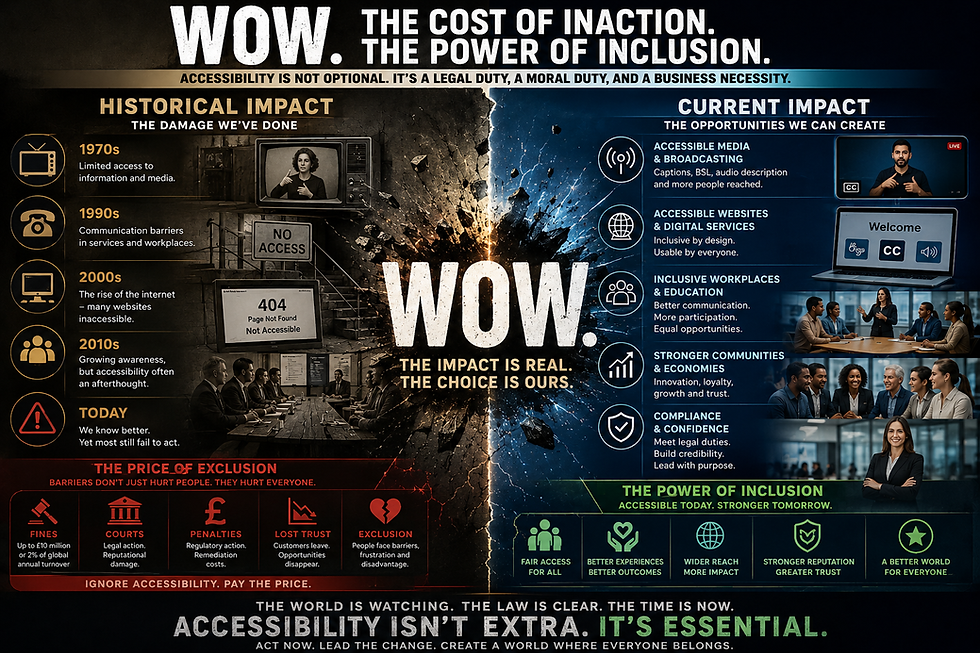
Many discussions about accessibility focus on the latest technology.
However, accessibility often develops in stages.
Organisations rarely move from zero accessibility to advanced accessibility overnight.
Instead, they progress through a journey.
Step 1: Awareness
This is where many organisations begin.
They recognise accessibility matters.
They understand inclusion is important.
They start asking questions.
At this stage, curiosity is often more important than expertise.
Step 2: Compliance
The next step is understanding standards and responsibilities.
This includes:
WCAG guidance
Accessibility legislation
Internal policies
Procurement requirements
Risk management
Compliance is often viewed negatively.
Yet it provides an important foundation.
Without standards, accessibility can become inconsistent and difficult to maintain.
Step 3: Accessibility by Design
At this stage, accessibility is no longer treated as an afterthought.
It becomes part of planning.
Part of procurement.
Part of development.
Part of content creation.
Instead of fixing barriers later, organisations begin preventing them from being created.
Step 4: Communication Choice
Once accessibility becomes embedded, organisations can focus on user experience.
Different people access information in different ways.
Some prefer captions.
Some use sign language.
Some require translation.
Some benefit from simplified content.
The focus shifts from providing access to providing meaningful choice.
Step 5: Accessibility Platforms
As accessibility grows, complexity grows with it.
Organisations manage websites, social media, training materials, internal communications, customer services, and broadcasting content.
This is where platforms become important.
Imagine a single dashboard that allows organisations to:
Upload content once
Manage sign language content
Manage captions and subtitles
Generate compliance reports
Monitor accessibility performance
Track engagement
Provide multiple communication options
The objective is not simply accessibility.
The objective is accessibility at scale.
Step 6: AI Enhancement
Only now does AI enter the conversation.
Not as the starting point.
As an enhancement.
AI may help reduce accessibility gaps.
AI may support content creation.
AI may assist with translation and communication.
AI may help organisations scale accessibility more effectively.
However, AI cannot replace the foundations that come before it.
Accessibility standards.
User testing.
Quality assurance.
Lived experience.
Human expertise.
Without those foundations, AI simply risks accelerating existing problems.
Why This Matters
Recent accessibility reports continue to show that the vast majority of websites still contain detectable accessibility issues.
This tells us something important.
The challenge is not always a lack of technology.
The challenge is often implementation.
Many organisations are still working through awareness, compliance, and
accessibility by design.
That is not failure.
That is progress.
Looking Ahead
Perhaps we spend too much time asking what AI will do for accessibility in the future.
Perhaps a better question is:
Where are organisations today on their accessibility journey?
Before we discuss advanced technology, we must first ensure the foundations are strong.
Accessibility is not a destination.
It is a process of continuous improvement.
And every organisation starts somewhere.
The goal is not perfection.
The goal is progress.
One step at a time.


Comments